Discover Your
Brain Age
BrainAgeTest.com is a free online brain age test designed to measure memory, focus, reaction speed, and cognitive performance through interactive challenges. Evaluate your mind in just a few minutes.
Five science-inspired cognitive challenges in one quick test. Try it now →
How It Works
Our cognitive tests are designed to be simple, quick, and engaging.
Take the Test
Complete a series of short and engaging cognitive challenges.
Analyze Performance
We analyze your results across multiple cognitive areas.
Get Your Brain Age
Receive your brain age score and a personalized breakdown.
Our Brain Tests
Challenge different areas of your cognitive skills.
Begin Your Brain Age Test
5 quick challenges. 2 minutes total. Instant results.
Ready to Test Your Brain?
You'll complete 5 short challenges measuring different cognitive abilities. Stay focused and respond quickly!
What Is Brain Age?
Brain age is an estimate of how well your brain is performing compared to typical performance ranges for different age groups. It is calculated based on memory, reaction time, focus, and problem-solving ability — not the number of years you have lived.
Our brain age test is not a medical diagnosis. It is an engaging, interactive way to understand your cognitive strengths and the areas where a little training could help.
Important: Our tests are for educational and entertainment purposes only and are not a substitute for professional medical advice. Learn more in our Disclaimer.
Understanding Your Brain
The science behind cognitive performance and mental sharpness.
A brain age test is an interactive cognitive challenge that estimates how well your brain is performing compared to typical ranges for different age groups. The brain age test on BrainAgeTest.com measures four core cognitive abilities — memory, focus, reaction speed, and mental processing — and combines them into a single estimated brain age score.
Unlike your chronological age, which is simply the number of years you have lived, your brain age reflects the current sharpness of your mind.
Two people who are the same age can have very different brain ages depending on their lifestyle, sleep quality, stress levels, diet, physical activity, and how much they challenge their minds. That is what makes a brain age test so interesting — it gives you a quick, tangible snapshot of where your cognitive performance stands today, and a benchmark you can track over time.
How Our Brain Age Test Works
Our brain age test is built around five short, scientifically-inspired challenges. Each one targets a specific area of cognitive function, and your performance on each is measured by accuracy and response time. The combined result produces your estimated brain age. Here is what each stage measures:
1. Memory challenge. You watch a sequence of highlighted patterns and reproduce it from memory. This tests your visual working memory — the same ability you can practice further on our dedicated memory test.
2. Pattern recognition. You identify the logic in a visual sequence and choose the piece that completes it. This measures reasoning and fluid intelligence.
3. Reaction speed. You respond as fast as possible when a signal appears. This measures processing speed and reflexes, which you can explore in depth on our reaction speed test.
4. Focus challenge. You find target symbols hidden among distractions, measuring selective attention. Our standalone focus and attention test goes even deeper into this skill.
5. Quick math. You solve rapid arithmetic problems, measuring cognitive processing speed under time pressure.
Once all five stages are complete, the scores are weighted and combined to estimate your brain age, along with individual breakdowns for memory, focus, reaction, and cognitive speed. If you would prefer a lighter, fun version, try our mental age test instead, which is a personality-style quiz rather than a performance test.
What Is Brain Age?
Brain age is a way of describing how well your cognitive functions are performing compared to typical performance ranges for different age groups. It reflects the current state of mental faculties like memory, attention span, processing speed, and decision-making ability.
The concept has become popular in consumer cognitive testing because it offers a relatable way to think about mental fitness. Brain age is not a medical diagnosis, but it can provide a useful snapshot of where your cognitive performance currently stands and how it might be improved through targeted exercises, healthier habits, and consistent mental training.
Cognitive performance is typically measured through tasks that assess multiple brain functions at once. These functions include working memory (holding and manipulating information temporarily) and executive function (planning, decision-making, and self-control).
Two other key functions are processing speed (how quickly you take in and respond to information) and attention (focusing on relevant information while filtering out distractions). You can read more about the science of cognitive testing on this overview of cognitive testing.
Memory and Focus: The Foundation of Cognitive Health
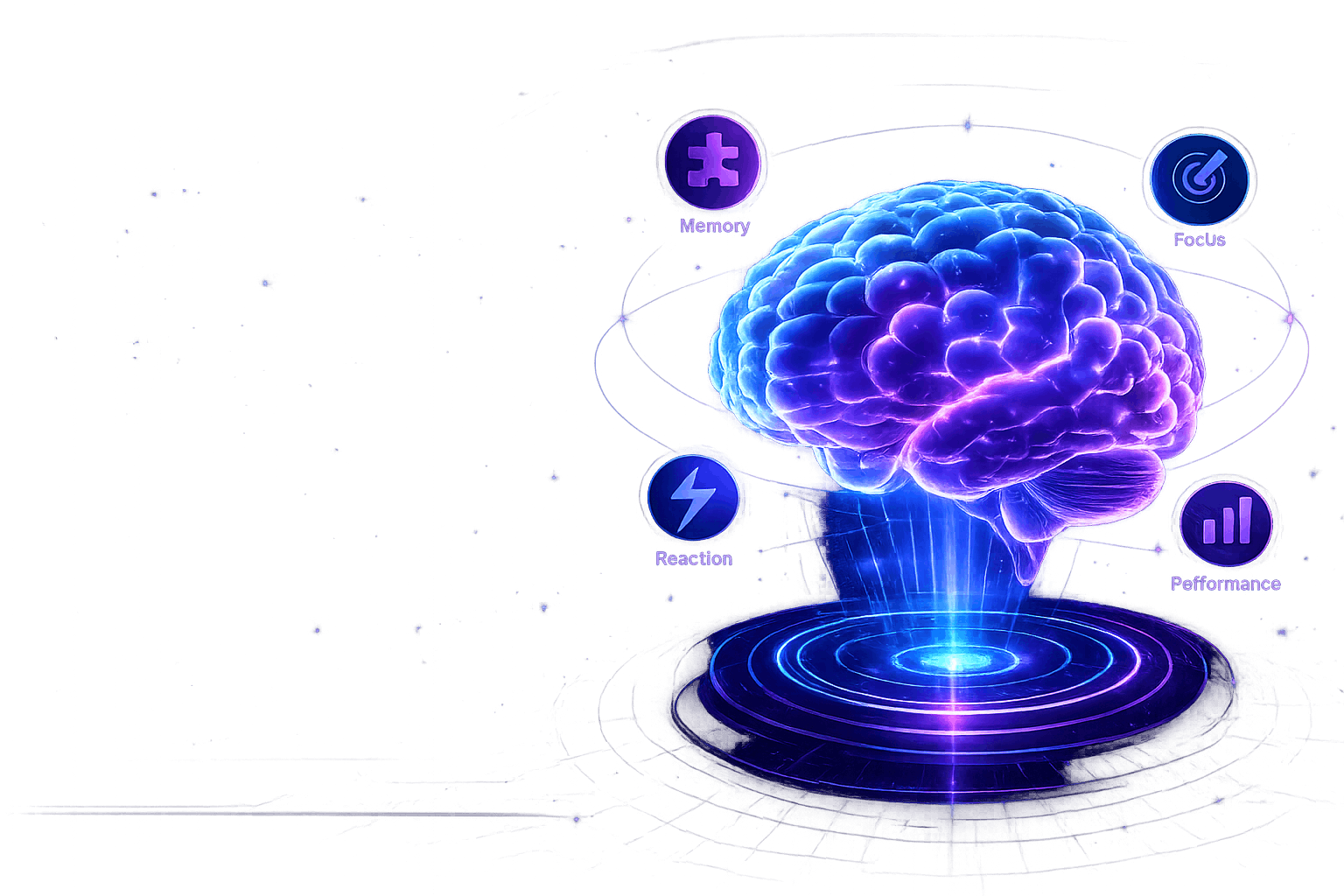
Memory and focus are two of the most important pillars of cognitive function. Memory allows you to learn new information, recall experiences, and apply knowledge in everyday situations. It includes short-term memory, which holds information for seconds to minutes, and long-term memory, which can last a lifetime. Our memory challenge tests your short-term recall by asking you to remember a sequence of patterns and reproduce it correctly.
Focus, or sustained attention, is your ability to concentrate on a specific task while filtering out distractions. Strong focus is helpful for learning, problem-solving, and productivity, and people with better attention tend to perform higher across cognitive tasks. Our focus challenge requires you to spot specific targets quickly within a busy visual grid, mimicking real-world scenarios where attention matters most.
How Brain Age Is Calculated
Brain age is calculated by comparing your performance against typical ranges for different age groups. When you complete each challenge, your score is calculated based on accuracy, response time, and consistency. The memory challenge rewards longer recalled sequences, the reaction test rewards faster response times measured in milliseconds, the focus analysis rewards speed and precision, and the math and pattern challenges reward quick, accurate answers. These individual scores are weighted and combined to produce an overall estimated brain age.
It is important to understand that brain age is an indicator for educational and entertainment purposes, not a diagnosis. A younger brain age suggests strong cognitive performance, while an older brain age may simply indicate areas where mental training, lifestyle changes, or more rest could help. Regular testing — done weekly or monthly — can reveal interesting trends in your scores over time and help you identify where to focus your improvement efforts.
Why Cognitive Performance Matters
Cognitive performance affects nearly every part of daily life. Strong memory helps you learn faster and retain what matters. Good focus lets you complete work efficiently and avoid costly mistakes. Quick processing speed supports better decision-making, safer reactions while driving, and sharper performance under pressure.
As people age, some cognitive functions naturally slow down. But research consistently shows that an active lifestyle, quality sleep, regular mental challenges, social engagement, and good nutrition can help maintain and even improve cognitive performance over time.
This is why tracking your brain age periodically can be valuable. It is not about a single number — it is about awareness. By taking the test regularly and observing trends, you can notice when your scores dip (perhaps during periods of poor sleep or high stress) and when they improve (after building healthier habits). Think of it as a fitness tracker for your mind: a simple, repeatable way to stay connected to how your brain is performing and to stay motivated to keep it sharp.
Whether you are curious about your mental sharpness, want to track your performance over time, or simply enjoy a quick mental challenge, our brain age test offers an engaging way to explore how your mind works. Ready to begin? Take the full test above, or try one of our focused cognitive challenges.
Frequently Asked Questions
Common questions about how the brain age test works.